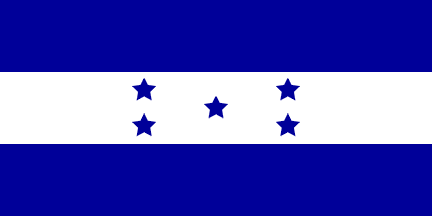
Honduras was a part of the ancient Mayan civilization back before the Incas and the Aztecs ruled. Copan, a city and touristic attraction in Honduras, was a major site for the Mayan civilization. Copan is a series of Ruins, and many people visit there each day to see Honduras's history. Honduras was, like many other Latin American countries, owned by Spain's vast empire in the New World. Although, Honduras became independent on September 15, 1821. During the 1980s, Honduras proved for a anti-Sandinista contra fighting the Marxist Nicaraguan Government and was an ally to Salvadoran Government leftist guerrillas. After two and a half decades of military rule, a freely elected civilian government came into power in 1982. Honduras has gone through many tragedies. Including a devastating hurricane, Hurricane Mitch, which passed in 1998 and killed about 5,600 people and caused a lot of damage adding up to$2 billion.
I, myself am from Honduras, and honestly I am proud of that. Taking this class made me realize that my country did go through a lot in its history. I never thought my country was active enough or even known to other people, but it all changed when I took this class. I learned that there was a strong military presence during the 1980s because there was a U.S. naval base here. I have been to Honduras many times and there is a lot to look at. You can see the beautiful mountains from wherever you because they are so big and gorgeous. One thing that turns me off in Honduras are the gangs. Yes, there are gangs in Honduras, and yes it is serious. The Mara Salvatrucha(MS-13), and the Mara 18 have a strong presence in Honduras and throughout Central America and some parts of the United States. It's hard for me to mention, but while vacationing over there I had came in contact with gang members. It is very dangerous to walk around at night even in downtown, because they usually come out at night. They don't care who you are, or what you do, they'll still find a was to kill you. Thank God, for the past two years, my Grandma has told me that the gangs have calmed down a little and have moved to other places. Honduras is a great place to visit, lots of history and cultural things to learn and see, and I recommend to go.
Right now, there are no primary concerns of individuals. The current president of Honduras Manuel Zelaya who runs a democratic constitutional republic. One thing I forgot to mention are the Garifuna people. They are tribe of Mullatos who have a good presence in Honduras. They even have their own style of music called "punta", it is a form of afro-pop because of its use of African drums. It is popular in Honduras. Everybody knows how to dance it. Punta is a fast paced style of music.
Here are some statistics that follow my project:
GDP- Per Capita: $3,300
Infant Mortality Rate: 24.61 deaths/1,000 live births
Life expectancy: 69.37 years, for males it is: 67.81 years, and for females it is: 71.01 years.
Literacy Rate: Age 15 and over can read and write, which is a total of 80% of Hondurans
These numbers are not so good. This is because Honduras is one of the 10 poorest countries in the Western Hemisphere. The economy is continuing to grow slowly, but average wages are low.
Ruinas de Copan video.
The Ruins of Copan. This Pre-Columbian city is know today as Copan. It was a site of a major Mayan city. Today, Copan is a popular visitation site where tourists from all over the world come to see some of history's greatest infrastructures.
In Unit 4, we discussed the concepts of nationalism and revolution as responses to neo-colonialism. In a formal essay (remember the formal essay format), I want you to explain how the experience of neo-colonialism lead to a nationalist and revolutionary response. Use the examples of the Mexican and Cuban revolutions to illustrate your answer. Who in Latin American society do you think was most attracted to and inspired by the Mexican and Cuban revolutions? What did these revolutions accomplish and how did they, perhaps, also fail?
In a formal essay, I will talk about how neo-colonialism led nationalism and revolution in Latin America, as we have been talking about in class. One of the most inspired revolutions in Latin American history is the Cuban Revolution. Most revolts that happened in this region after the Cuban revolution were inspired by it. One of the leaders of the revolution was Ernesto 'Che' Guevara, who was an Argentinian who went to Mexico to meet up with future dictator of Cuba, Fidel Castro. From then on, they had worked together in starting on the most inspiring movements in history. Although the revolution was great and all, Cuba today is still ruled under a dictatorship. Presently, by brother of Fidel Castro, Raul Castro. Neo-colonialism is an idea of "new colonies", so once these countries were becoming banana republics and such and wanted to break off from eachother, the U.S. took advantage of these Latin American countries. The U.S. intervened in Latin American countries numerous times, and used their military to take control of these countries. Citizens of these countries did not like that, so the traditional way was to rebel. In the Cuban revolution, they tried to overthrow Fulgencio Batista because of his Marxist policies. This revolution by the people last from 1953- 1959. Many countries were inspired by the Cuban revolution, that some even started their own. For example, Argentina. Argentina went under a Dirty War where 30,000 activists "disappeared." I think that many students and organizations were attracted to and inspired by the Mexican and Cuban revolution because things were going wrong in their country and they wanted to lead a revolution to get what they wanted. Students are also influential people because they are educated and they know what they are doing. I think that they wanted to stand up for what the people believed in and not be run by a corrupt government. I think that organizations were inspired by the Cuban and Revolution because as a group they all wanted to participate in revolution against something they're not up for. Some revolutions accomplished something and some did. The Cuban revolution accomplished independence for Cuba from the U.S., but when Fidel came in power things weren't what they though they were going to be.
In this essay I want you to describe the concept of neocolonialism. What does the term mean? What are it’s economic and political underpinnings and outcomes? Make sure to include examples from the class. You should also discuss U.S. military interventions in Latin America as they relate to neocolonialism (describe at least three). You can use your class notes and your book to assist you.
Neocolonialism. What you have to do first is break the "neo" and "colonialism" apart to figure out what it means. Neo mean "new" and "colonialism" means a way to make new colonies in other places that have less power, kind of like Imperialism. So, to me Neocolonialism means "new colonies" or a new way to govern them. Neocolonialism can also refer to the involvement of powerful countries in the affairs of less powerful countries, like I said before. And we ALL know that the U.S. did A LOT of intervening in Latin America. To understand Neocolonialism, you have to look at the good and the bad. The good is that some countries in Latin America get what they want. For example, Panama wanted to become independent, Colombia wouldn't allow that because they were a whole. So, once the U.S. found out about this they told Panama that we would have their backs and in order to gain your independence you have to break away from Colombia. Well guess what happened? Good guess, but Panama did break away from Colombia, and in the end they got what they wanted. During the Neocolonization period, Latin America had also been relieving a major makeover by the U.S. and part of Europe. Railroad tracks in Latin America grew enormously, prior to the fact that they were primarily owned by European and U.S. companies. United States banana companies expanded throughout Central America. One thing that Latin America was doing right is that they were getting their cash flow! They were exporting goods and the U.S. paid them for it even though they were U.S. based companies. One important factor of this Neocolonialism period is the Roosevelt Corollary that was inspired by the Monroe Doctrine. The Roosevelt Corollary stated the right of the United States to intervene and stabilize the economic affairs of small nations in the Caribbean and Central America if they were unable to pay their international debts. From this point on the U.S. really started to intervene in parts of Central America and the Caribbean. Latin America let us intervene basically because they didn't have the money and they needed someone to go to, so they came to us because at that time we were a rising world power and we still are till this day. Three examples of U.S. military interventions are Nicaragua, Haiti, and the Dominican Republic. The intervention in Nicaragua is know as a fierce war between the Marines and the Nationalist guerrillas led by Augusto Cesar Sandino. The U.S. intervened many times from 1912-1933. Its because of Sandino that the Marxist movement in the 1960s was created and was called the Frente Sandinista de Liberacion Nacional (FSLN).
1. Who was the first of Latin American liberators we discussed in class, who launched an independence struggle in the late 1700’s? What country did he help liberate? What happened to the country after liberation? The first Latin American liberator who launched an independence struggle in the late 1700's was Touissant L'Ouverture. He helped liberate the country of Haiti from the French.
2. Name some of the individuals involved in the struggle for Mexico’s independence. Some individuals who struggles for Mexico's independence were Miguel Hidalgo and Jose Maria Morelos.
3. Who was Simón Bolívar? What did he achieve? How did he fail? Simon Bolivar was one the most important leaders who fought for independence from Spain. He achieved the liberation of the countries of Colombia, Venezuela, Peru, Ecuador, and Bolivia. He failed when he resigned from his presidency when he left for exile in Europe.
4. Who was José de San Martín? What did he achieve? How did his political career end? He was an Argentine leader and he was a leader of South American independence. He Liberated Chile and was appointed Protector of Peru. His political career ended when Peru was officially independent from Spain on July 28, 1821.
5. In the film The House of Spirits, the character Esteban is meant to represent what class and what economic system? In the film, Esteban comes from little to big things. In the film he represents the upper class- The Creole class. He is also the patron of his farm under the hacienda system.
6. In the film The House of Spirits, who does the character of Pedro represent? In the film, Pedro represents the working class. He represents the People's Party, and they won the election against the Conservative party, which Esteban had run for.
7. The film The House of Spirits is based on a book by a famous Latin American author. Who is the author and why was her father famous? The author of House of Spirits is Isabel Allende. Her father, Tomas Allende, was the Chilean ambassador to Peru and he was also first cousin to Salvador Allende, who was President of Chile from 1970-73.
Essay:
In a minimum of five paragraphs, try to answer the following questions:
1. Why did real democracy prove so elusive post independence in Latin America? 2. Why did so many of the newly independent nations of Latin America end up being ruled by Caudillos? 3. Why did political independence not bring economic prosperity to the masses of Latin America?
First of all, Democracy isn't something that we would think would have to deal with Latin America because they have never really had Democracy. For a period of time, the United States never game them the right of Democracy because we would always intervene in Latin American countries and have our military take control of them for a period of time. Or the military would overthrow the government and the country would either be ruled by a Dictatorship or by military. So in a sense, I've learned from reading and research that Latin America hasn't been given its Democracy yet, maybe one day, but so far their Democracy isn't well known. I think because Latin America never had a way to govern itself, they had to have Caudillos to take over in newly independent nations of Latin America. On a brighter side, Latin America did have a good way of bringing in cash flow in several different countries. Honduras had the bananas, Bolivia had the tin, Ecuador had the cacao, and Guatemala had the coffee. Other countries had other great exports too. But they let the US intervene in their affairs. For example, the dispute between Panama and Colombia. The only reason Panama broke away from Colombia is because the US said that they would back them up with our military force. Because they had no sense of politics or democracy, They would let the US take over countries with our military and we would stay there for 20+ years. The only reason the US is a good example of Democracy is because we know how to run a country(Apparently, not now because Bush is in office). We have laws that structure our government and we have a sense of authoritization. Latin America didn't have a way to run their independent countries and I guess that's a major factor in why democracy is absent. Political independence did not bring prosperity to Latin America because most likely after there were economical problems and there were revolutions and they were in search of political leaders to run the countries. And again thats why Caudillos ruled.
When I first saw what the chapter was called it said "Neocolonialism." I predicted that that chapter was going to be about "new colonies" or a new way of colonial times in Latin America. BUT what I found out was that Latin America went through a major modern change. Everybody's life changed in a prosperous way from the rich and the poor, to the urban a rural people in Latin America. For example, the Great Export Boom improved a lot for Latin America. Cuba with its sugar, Brazil with its coffee, Chile with their million dollars worth of mining, Argentina with its massive wheat production, Guatemala with their coffee, Honduras with their bananas, and Bolivia with its tin. Because of all the beneficiaries, the middle class in Latin America grew rapidly, especially in Argentina. Also in Brazil rubber was found and used to create the rubber for tires in the US. It's cool to learn how my people "came up" at this time in history, but what effect did the US have on Latin America when all this was happening?
In the previous chapter of "Independence", I learned a lot about the different ways that Latin America gained their independence. I enjoyed having discussions during class about the independence movements because I learn more when other people are talking because I learn more than just reading the information from the book. Now, in chapter 4, the first words right off the bat tell me what it is going to be about, which is Liberty, Equality, and Popular Sovereignty. I learned that Latin America divided the lines between Liberals and Conservatives. The Liberals were oriented toward progressive models and the Conservatives were going back toward colonial or Spanish models. I think in class we need to clarify the difference between the two parties more because I'm still a little questioned by them. There was at the time economic and institutional difficulties going on.A horrible economic devastation had occurred during the independence wars, but the Mexican and Peruvian silver mines were hit the hardest. Latin America produced the most silver in the world, but they had ran out of money after independence. Another problem was that there was a lack of transportation structure. There was a lack of navigable rivers. I prefer that we talk more about the Caudillo leadership and the politics that was present in the rest of the chapter because I don't understand much of it.
Well, it seems that once I have started reading the book, its keeps getting even more descriptive in it's content. I mostly understood the subjects that the author was talking about. One thing I didn't understand were the words "sedentary" and "semi sedentary." I learned more in depth about the things that went on before the "Encounter" or before Columbus's voyage to the Indies. I was really interested in Portugal's exploration of the West coast because it talked about the Slave Trade and how Africans were actually slaves in Iberia first before coming to America. It was interesting to read the birth of Spanish America after the falls of the Aztec and Inca Empires.
I read the first 25 pages of this book, and I thought it was very intriguing. Basically, from what I read, it explained the many populations of Latin American countries, whether they were big or small. The author also talked about how South America was the main place where slaves were bring imported. There were different political forces such as Nationalism and Liberalism that happened in the region.Basically, the whole chapter was just an introduction to what we are going to be reading in some information we need to know before reading.